The road to 2027 — how regulation and pilots are paving the way for the new data economy
Different jurisdictions around the world, from the EU to Singapore, are already building the legal framework that will support data as the next asset…
Datafund 5 min read
 Source: Datafund, Gemini
Different jurisdictions around the world, from the EU to Singapore, are already building the legal framework that will support data as the next asset class. But this alone is not enough. We still need a few additional components to create the entire stack that will cement data as an asset in its own right.
September 2025 Blog Post #4 in Datafund’s Data Tokenisation Series.
Read more:
Blog #3: From hospitals to AI — how data tokenisation will reshape industries
Blog #2: The missing asset — why data is RWA’s next frontier Blog #1: Data as a financial asset: A multi-billion dollar opportunity
In our previous blog, we explored how data tokenisation is beginning to transform industries — from hospitals and clinical research to AI. In this final part of the series, we turn to the foundation that will make this transformation possible: the regulatory and institutional frameworks being built right now.
A regulatory foundation quietly taking shape
While there are numerous cases that speak in favour of tokenising data as an asset, 2025 won’t be the year of mass adoption. It will be remembered, though, as the year data tokenisation went from theory to trial.
Regulators from Europe to Asia are laying the groundwork. From MiCA in the EU to Singapore’s Project Guardian, the recognition of data as a distinct asset class is gathering momentum.
Dubai stands out as a leader. Through VARA, its dedicated digital asset regulator, the emirate has established a framework that balances innovation with investor protection. This clarity is already attracting major tokenisation projects and positioning Dubai as a global hub for digital asset infrastructure.
Meanwhile, technologies that once sounded purely theoretical are now being deployed at scale. Homomorphic encryption and federated learning make it possible to analyse data without ever exposing it, preserving privacy while unlocking insight.
Together with emerging pilots, these developments signal that the transition from theory to practice has begun. The results of these early trials will influence data regulation and market design for decades to come.
Why previous attempts fell short
Early data marketplaces — many launched during the last blockchain cycle — failed because they mistook data sales for data ownership. They built transactional platforms rather than asset frameworks. A dataset on a ledger, however, is still just a dataset. For data to become an investable asset, it must rest on a foundation of:
-
Legal recognition as a property class
-
Standardised valuation methodologies
-
Compliance systems that satisfy regulators
-
Privacy-preserving technical infrastructure
-
Incentives that align all participants
The coming wave of tokenisation efforts recognises that this is not a technology problem but an institutional one.
Looking ahead to 2027: From pilots to exchange-traded assets
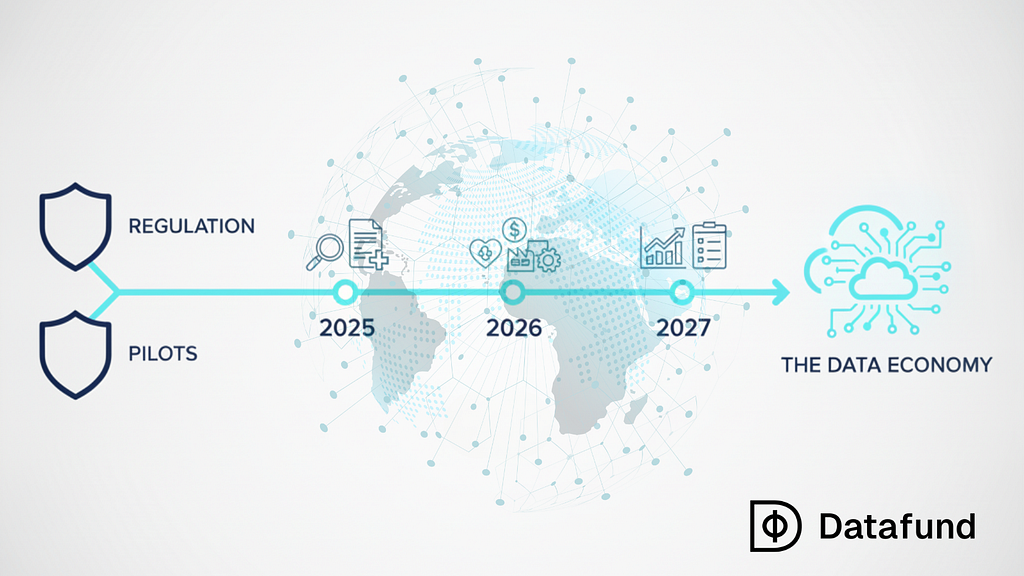
The timeline is becoming clear. 2025 will see the emergence of regulatory pilots — focused, high-value experiments designed to test governance, valuation, and compliance. By 2026, the first working implementations will go live, centred on medical, financial, and industrial data. And by 2027, accounting standards will begin to reflect tokenised data on balance sheets. The first data-backed securities will likely trade on regulated exchanges.
The strategic opportunity
-
For healthcare systems, the imperative is to start mapping and classifying high-value datasets, establishing governance standards before regulation catches up.
-
For investors, mastering data valuation will become as essential as analysing equities or real estate. Those who understand how data compounds in value will have a first-mover advantage when this asset class matures.
-
For technology companies, the opportunity lies in infrastructure — from valuation models and tokenisation frameworks to compliance and storage systems. The firms building these tools today will quietly become the backbone of the next digital economy.
-
And for policymakers, the message is clear: the jurisdictions that combine clarity with flexibility will shape the geography of the data economy. Dubai’s VARA framework has already shown how regulatory foresight attracts capital and innovation rather than driving it away.
Beyond finance
The consequences of recognising data as an asset go far beyond financial markets. It could transform how societies fund research, how AI models are trained, and how individuals benefit from the value they help create.
-
Medical research would accelerate as data sharing becomes economically rational rather than purely altruistic.
-
AI development would become fairer, with communities sharing in the returns generated by their contributions.
-
Transparency would replace the opaque, unregulated trade in private datasets.
-
Global collaboration would become feasible without sacrificing national or individual data sovereignty.
The next chapter of the digital economy
The convergence of regulatory clarity, technical maturity, and market demand has made data tokenisation inevitable. The question is not whether it will happen, but how — and who will shape its early architecture.
Those who see data not just as a resource to exploit but as an asset to cultivate will define the next era of the digital economy. The groundwork being laid today — particularly in Dubai, Singapore, and Europe — will determine who benefits when the tipping point arrives.
If you liked this content, keep following us for more on:
X
or get in touch via:
[email protected]
The road to 2027 — how regulation and pilots are paving the way for the new data economy was originally published in Datafund on Medium, where people are continuing the conversation by highlighting and responding to this story.
First published on Medium on 2025-10-07.