Decentralised storage for tamper-proof data provenance
Decentralised storage on Swarm offers an alternative way to track the origin of data in a permissionless and tamper-proof way.
Datafund 5 min read
 Source: Datafund, Gemini
Decentralised storage on Swarm offers an alternative way to track the origin of data in a permissionless and tamper-proof way.
The modern digital economy relies extensively on centralised cloud providers. Services like Amazon Web Services (AWS) offer significant scale and convenience, alongside features for data immutability.
However, these systems are fundamentally architected with specific trade-offs, where efficiency and consistency often take precedence over decentralised autonomy.
The extent of issues that can be caused by relying on such a centralised model were demonstrated by the recent AWS outage. Numerous private enterprises, including banks, as well as public services (the UK’s tax administration), were unavailable for hours.
This highlighted a key aspect: integrating core infrastructure within a single, interconnected ecosystem can introduce a significant single point of failure.
This post examines a different architectural approach. As a recipient of the Swarm Foundation’s fellowship to develop a Web3 tool for data provenance, our focus in this blog will be on why we chose Swarm’s decentralised storage for it.
We will also explore why the network’s immutability and high availability by default are particularly well-suited for creating verifiable data origin trails. Let’s begin.
Cryptographic hashes as a foundation for immutability
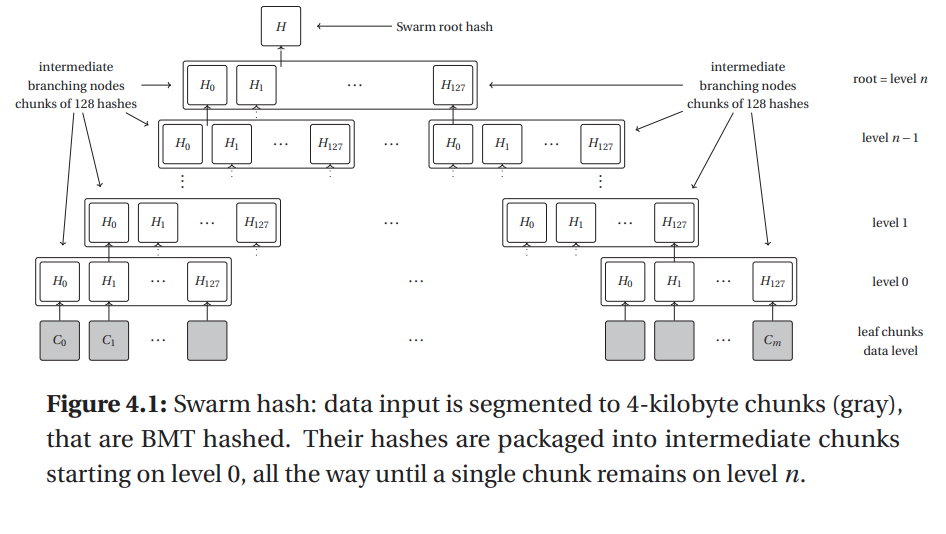
Our primary reason for selecting Swarm is its native support for immutability, which is a direct consequence of its use of content-addressed storage.
When a file is uploaded to Swarm, its content is used to generate a unique cryptographic hash. This hash serves as the address for the logical location of data within the network.
 Source: The Book of Swarm
This mechanism provides two key functions:
-
Data integrity verification: The hash is a cryptographic fingerprint of the data. Any alteration to the original data will result in a completely different hash. This allows any user to verify that the retrieved data is identical to the data that was originally stored.
-
Decentralised retrieval: The hash is used to locate and retrieve the data from the network’s peer-to-peer nodes. As long as the data corresponding to the hash exists on any node, it remains accessible.
For provenance tracking, this design is highly desirable. Each event in a dataset’s lifecycle — such as creation, transformation, or use as a model input — can be recorded and linked to its Swarm hash. The hash thus becomes a permanent, immutable and verifiable reference point.
While Swarm itself doesn’t timestamp uploads, Datafund is developing this functionality as part of the toolkit. It will enable timestamps for all uploads and savng them on the blockchain. In turn, this will create a fully auditable and trustless history of any data usage.
High availability through peer-to-peer design
 Source: Gemini
A second key advantage of Swarm’s architecture is its high availability. In a peer-to-peer network such as Swarm, data is replicated across multiple, geographically distributed nodes. This redundancy means that the system is highly resilient to individual node failures.
Even if a number of nodes go offline, the provenance data remains accessible and verifiable. As long as the person or entity retains control of the hash and a sufficient number of nodes storing the data chunks remain online, the data will remain available.
Swarm’s persistence and permissionless access are, therefore, an integral part of the network’s design.
This contrasts with traditional storage systems where, despite encryption and version control, data availability is ultimately dependent on the provider’s infrastructure and, more importantly, operational practices.
Provenance in the context of AI development
The need for robust data provenance is particularly acute with the rise of generative AI.
As noted by Huang et al., if:
“GenAI models are to be scrutinised, adopted and built upon, the data they are trained on must be beyond reproach.”
Compromised or flawed data collection can undermine the validity of scientific inquiry and lead to models that produce biased or unreliable outputs. By using training data whose lineage is tracked with Datafund’s provenance tool on Swarm, developers can:
-
Trace model inputs back to their verified sources.
-
Provide auditable proof of compliance with data licences.
-
Detect unauthorised data manipulation or contamination by verifying cryptographic hashes at each stage.
In essence, a decentralised approach to provenance provides a technical foundation for trust.
Building the provenance layer for the decentralised web
We are developing our provenance toolkit to help establish a new standard for verifiable, tamper-resistant evidence of data origin and usage. Swarm provides the necessary infrastructure: a decentralised, durable, and cryptographically secure storage layer.
The next step will be to provide access to the tool for early adopters and collaborators. If you are exploring methods to prove the authenticity of your data, are involved in building AI models or managing research datasets, your technical perspective would be invaluable.
X
or get in touch via:
[email protected]
Decentralised storage for tamper-proof data provenance was originally published in Datafund on Medium, where people are continuing the conversation by highlighting and responding to this story.
First published on Medium on 2025-10-24.